

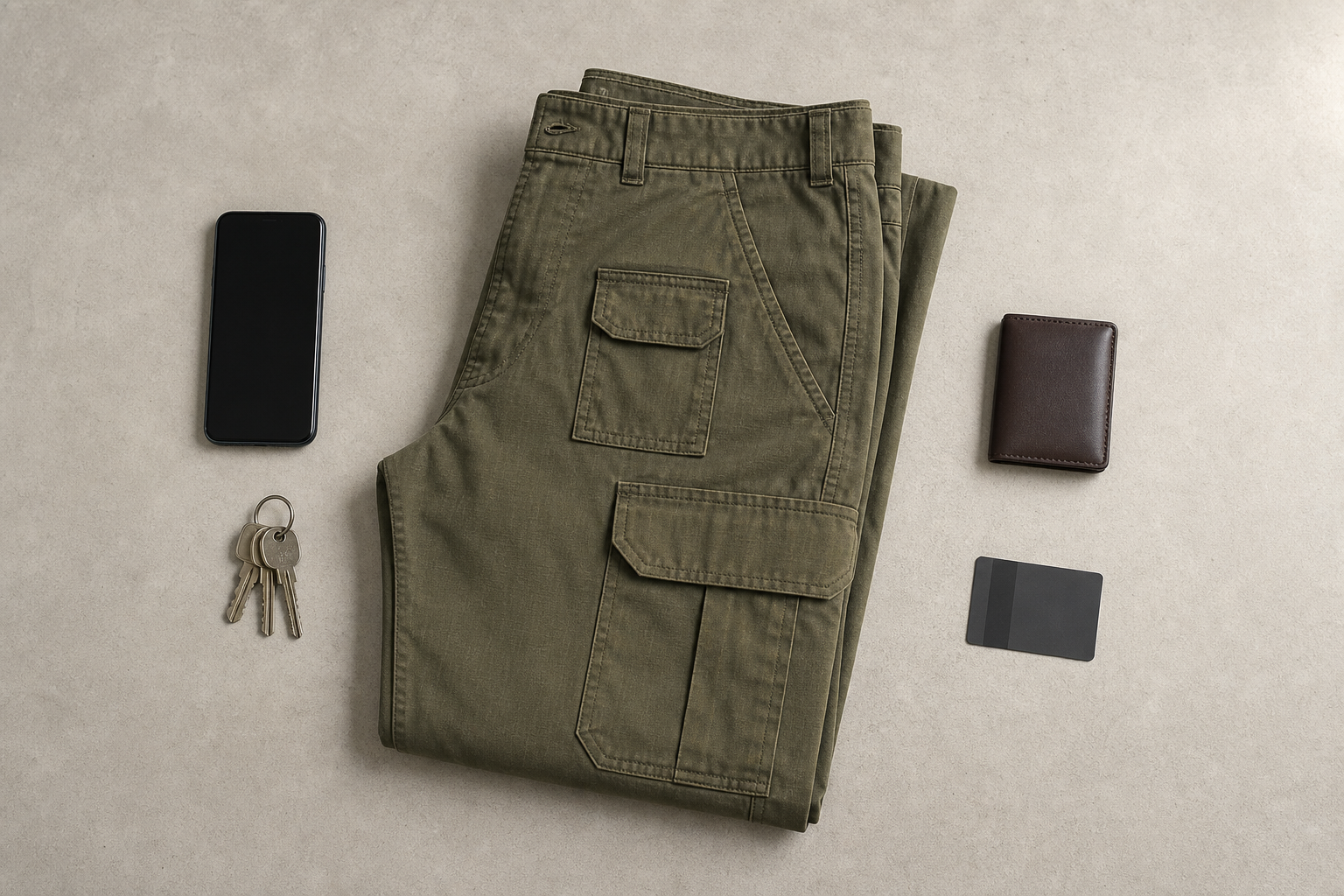
The best cargo-pants pocket layout is the one that matches what you actually carry. A pair for commuting may need easy phone access and one secure pocket, while a travel pair may benefit from more separation. Pocket count alone does not tell the full story: position, closure, depth and the amount of bulk all affect how the pants feel during a normal day.
This guide explains the common pocket types you may see while shopping and gives you a simple way to compare them. Because layouts vary by item, always confirm the product photos and description before ordering.
Read pocket names in three parts
A pocket can be described by its position (hip, thigh or rear), its construction (flat or expandable), and its closure (open, flap or zip). These are not competing categories: a thigh cargo pocket may also have a flap and an expandable shape. A flap is a cover, not proof of a fastening beneath it.
This guide helps you identify the layout. For a device-specific buying check, use our cargo pocket depth and phone-fit guide.
What are the main cargo-pants pocket types?
Most cargo pants combine ordinary hand pockets with one or more storage pockets on the leg. The exact combination changes by style.
Hand or slash pockets
These sit near the hips and are designed for quick access. They can be convenient for a phone or small everyday item, but the opening angle and pocket depth determine how secure the contents feel when you sit. Look at the front and side product photos to judge where the opening begins.
Thigh cargo pockets
These are the defining pockets on many cargo styles. Their lower position can separate larger items from the hip area. A flatter pocket creates a cleaner outline, while a pleated or expandable design can create more space. More space can also mean more movement or bulk when the pocket is filled.
Zip or other secured pockets
A closure can be useful for an item you do not want to slip out during movement. Compare how easy the closure will be to use with one hand, and consider whether the hardware sits where it may press against a chair. Do not assume every visible zipper opens into storage; confirm that detail on the individual product page.
Rear pockets
Rear pockets may be open, covered or secured. They can provide extra separation, but a bulky object may be uncomfortable while sitting. Many shoppers prefer to reserve these pockets for thin, lightweight items.
Flat patch pockets versus expandable pockets
A flat patch pocket lies against the garment when empty. An expandable pocket has extra material, such as a fold or side panel, that can open out. Look at side-view and close-up photographs: a large flap alone does not reveal how much space is underneath. Likewise, decorative seams can resemble a pocket without providing an opening.
Use these observations to shortlist styles, not to estimate capacity. The size of the outer patch is not necessarily the usable size of the pocket bag.
Choose a layout by what you carry
| Typical need | What to compare | Useful question |
|---|---|---|
| Daily phone access | Opening position and depth | Can I reach it without shifting the waistband? |
| Keys or small valuables | A secure, separate compartment | Will hard items rub against my phone? |
| Commuting | Comfort while seated | Does the pocket or closure sit against the chair? |
| Travel days | Separation and closure | Can I keep essentials organized without overfilling? |
| Cleaner styling | Low-profile pocket construction | Does the pocket lie flat when empty? |
Why more pockets are not automatically better
An impressive pocket count can sound useful, yet comfort depends on how those pockets are used. Filling every compartment adds weight and may change how the pants hang. It can also make frequently used items harder to remember or find. Start with a short carry list, then choose enough separation for that list instead of maximizing the number.
Balance matters too. Loading one side with a phone, wallet and keys can pull unevenly. If you carry several items, distribute them between sides or move heavier objects to a bag. The pants should support the way you dress; they do not need to replace every other form of storage.
A five-step pocket check before buying
- Write down your real carry list. Include only what normally stays on you.
- Study every product image. Look for openings, flaps, zippers and the height of each pocket.
- Read the item description. Verify whether decorative details are functional.
- Consider your longest activity. Sitting, walking and driving place pressure in different areas.
- Leave some room. A pocket that is filled to its limit can affect comfort and the line of the pants.
How pocket placement changes the look
Higher, flatter pockets tend to stay closer to the leg. Lower or expandable pockets create a more obvious utility profile. Neither is universally better. A streamlined style can pair easily with a simple tee or overshirt, while a more dimensional pocket can become the visual focus of the outfit.
Colour and fabric also affect how visible the pocket structure appears. Tonal stitching can make the layout subtle; contrast details can emphasize it. Use close-up photos rather than relying only on the product title.
Frequently asked questions
Which cargo pocket is best for a phone?
Choose an opening that is easy to reach, deep enough for the device and positioned comfortably when seated. Because phone sizes and pocket dimensions vary, compare the listing carefully rather than relying on the pocket label.
Are zipper pockets always more secure?
A fully closed pocket can reduce the chance of an item slipping out, but security also depends on the zipper, opening and fit. Check that the pocket is functional and that the closure will not create pressure during your usual activities.
Should cargo pockets be filled completely?
Usually, no. Overfilling can add bulk, pull the garment unevenly and make items harder to access. Carry the essentials and use a bag when the load becomes heavy.
Explore cargo styles with a purpose
Once you know which layout fits your routine, compare the current modern cargo collection and cargo styles. Check each listing for the exact pocket construction, materials, sizing and care information before choosing.
Bottom line: start with what you carry, then judge access, closure, comfort and bulk. That approach is more reliable than choosing by pocket count alone.